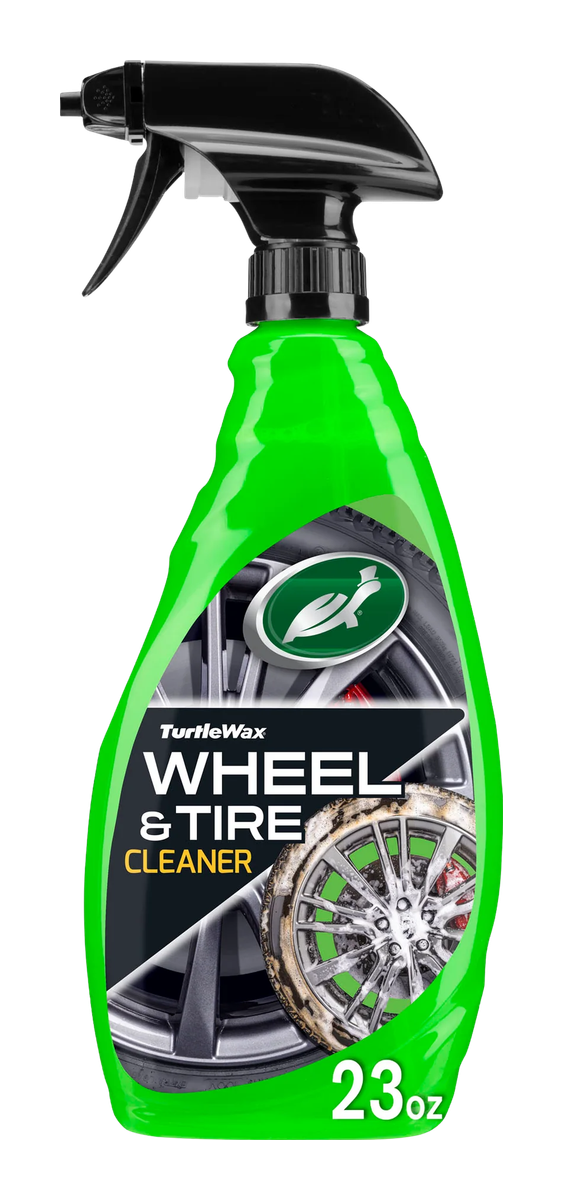
Turtle WaxWheel & Tire Cleaner
Updated · 23 ingredients analyzed
$0.35BEST $/OZ
A ready-to-use alkaline wheel cleaner formulated with sodium metasilicate pentahydrate for heavy brake dust removal on consumer vehicles. Turtle Wax Wheel & Tire Cleaner ranks #5 of 38 wheel cleaners for cleaning power.
Key Chemistry
pH
12–14
Active Mechanism
alkaline saponification
Surfactants
7 (anionic, nonionic, amphoteric, cationic, amine_oxide)
Expert Analysis
Uses sodium metasilicate pentahydrate as the primary alkaline builder at pH 13 to break down brake dust and road grime through chemical dissolution. The formula incorporates a comprehensive surfactant system with anionic, nonionic, amphoteric, cationic, and amine oxide types to provide thorough cleaning and soil suspension across different contamination types.
Key Differentiators
- •High alkalinity at pH 13 for aggressive brake dust dissolution
- •Comprehensive five-surfactant system for broad-spectrum cleaning effectiveness
Ingredients
Dipropylene glycol monomethyl ether
1–10%
CAS: 34590-94-8Solvent
Sodium metasilicate pentahydrate
1–10%
CAS: 10213-79-3Chelating agent
sodium hydroxide; caustic soda
1–10%
CAS: 1310-73-2pH adjustment
Cocamidopropyl betaine
0.1–1%
CAS: 61789-40-0Surfactant
Water
N/D
CAS: 7732-18-5Solvent
Sodium Metasilicate
N/D
CAS: 6834-92-0Chelating agent
Sodium Caprylyl Sulfonate
N/D
CAS: 5324-84-5Surfactant
C9-11 Alcohols Ethoxylated
N/D
CAS: 68439-46-3Surfactant
Cocamidopropyl Betaine
N/D
CAS: 70851-07-9Surfactant
Butoxydiglycol
N/D
CAS: 112-34-5Solvent
Potassium Hydroxide
N/D
CAS: 1310-58-3pH adjustment
Lauramine Oxide
N/D
CAS: 1643-20-5Surfactant
Isopropanol
N/D
CAS: 67-63-0Solvent
Sodium Sulfate
N/D
CAS: 7757-82-6Thickener
Sodium Tolyltriazole
N/D
CAS: 64665-57-2Processing aid
Glycerin
N/D
CAS: 56-81-5Humectant
Myristamine Oxide
N/D
CAS: 3332-27-2Surfactant
Cocamidopropyl Dimethylamine
N/D
CAS: 68140-01-2Surfactant
Chloroacetic Acid
N/D
CAS: 79-11-8Trace Contaminant
Dichloroacetic Acid
N/D
CAS: 79-43-6Trace Contaminant
Ethylene Oxide
N/D
CAS: 75-21-8Nonfunctional ingredient
Acetaldehyde
N/D
CAS: 75-07-0Trace contaminant - Solvent
Ethylene Glycol
N/D
CAS: 107-21-1Trace contaminant - Solvent
Safety Profile
Signal Word
DangerEye Hazard
H318 - Causes serious eye damage (implied by H314)Skin Hazard
H314 - Causes severe skin burnsCorrosive to Metals
NoFlammable
No